What Types of Security Doors Are Best for Homes?
Choosing the right security doors starts with understanding what they must resist: forced entry, weather exposure, or both. A sturdy door slab matters, but so do its frame, hinges, lock, and installation. Details matter.
The FBI’s Crime Data Explorer tracks burglary as a distinct property crime, although its national figures do not identify which door or lock was involved. That limitation matters: crime statistics cannot prove that one door material is best for every home. CISA’s layered-security guidance offers a practical principle instead—security works best when several measures support one another.
This guide compares reinforced steel, solid-core wood, fiberglass, and security screen doors, along with options for patio entrances. Steel can provide a rigid barrier, while solid-core wood may suit homeowners who value a traditional appearance. Fiberglass offers another balance of durability and upkeep. For sliding doors, the frame, track, and locking system deserve close attention. Not just the slab.
ASTM F476 provides test methods for assessing the security of swinging door assemblies. A test standard offers useful evidence, but it cannot guarantee performance in every home or installation. That is worth remembering. The best choice depends on the entryway, local conditions, and how the complete assembly is fitted. The comparisons ahead focus on those practical differences, so readers can assess claims without treating any single material as a complete security solution.
Security Door Basics: Compare Steel, Solid-Core Wood, Aluminum, and Mesh
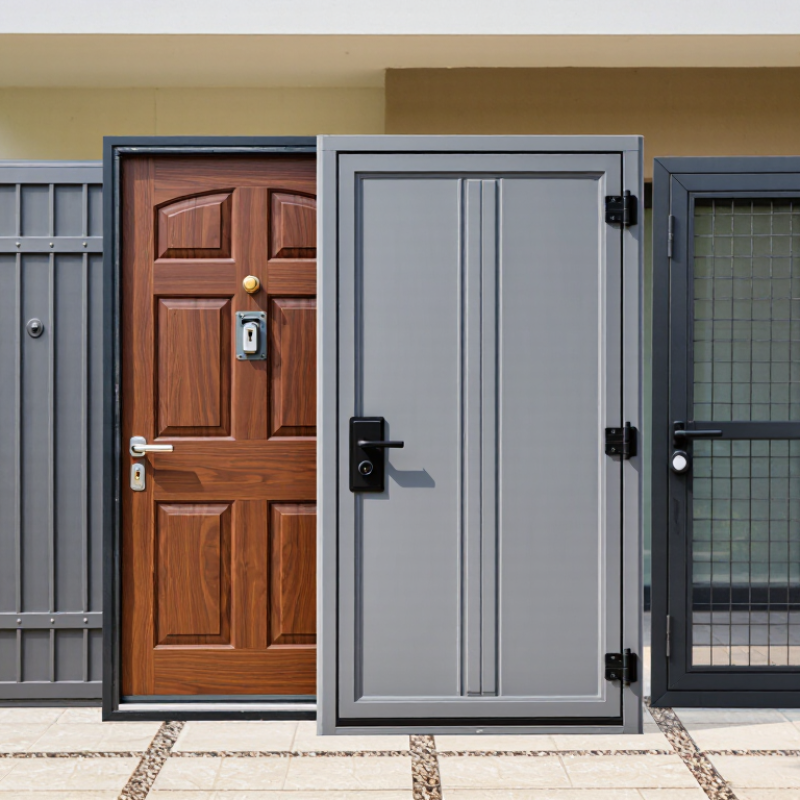
Steel doors provide a strong physical barrier and resist everyday impacts, especially when paired with a reinforced frame and secure hinges. They can be heavy, though, and damaged coatings may allow rust to develop in damp or coastal conditions. Check the finish regularly. Small scratches matter.
Solid-core wood doors feel substantial and can suit homes where appearance matters as much as security. Their performance depends on the core, frame, and hardware; a decorative outer layer does not guarantee a solid interior. Wood may also swell or warp with moisture, so exposed entryways need suitable protection.
Aluminum doors are lighter and naturally resist corrosion, but their strength varies with design and construction. Mesh security doors offer airflow and a clear view of the porch, yet mesh alone is not a substitute for a strong door. Look closely at the mesh, frame, hinges, and lock together. A weak frame can undermine a strong panel. Fit matters, too. In practice, the best choice depends on exposure to weather, household needs, and careful installation. It is easy to focus on the door material and overlook the frame.
Door-Set Testing: EN 1627 Defines Six Resistance Classes, RC1–RC6
What Types of Security Doors Are Best for Homes?
Door-Set Testing: EN 1627 Defines Six Resistance Classes, RC1–RC6
EN 1627 rates complete door sets, not just door leaves. The frame, lock, hinges, and fitting details all matter. Classes run from RC1 to RC6, with resistance generally increasing at each level. RC1 offers basic resistance to force; RC2 and RC3 address attempts using common tools. Higher classes are tested against more capable tools and attacks. These ratings describe performance under controlled tests, not a promise that entry is impossible. A sturdy door can still underperform if its frame is poorly anchored.
Tips: Check the certificate for the exact door-set model and class. Ask whether the tested configuration matches your opening, including glazing and hardware. Confirm installation requirements before ordering.
For many homes, RC2 or RC3 may be a practical starting point, depending on location and risk. A quiet ground-floor entrance beside a hidden alley may call for a different choice than a visible apartment entry. Look closely at the threshold and strike area; small fitting gaps can undermine confidence. Higher resistance can add cost and weight, too. The decision is not perfectly tidy: a strong door is only one part of home security.
What Types of Security Doors Are Best for Homes?
EN 1627 classifies door-set resistance in six classes, from RC1 to RC6. Higher classes indicate resistance to more demanding attempted break-in methods.
The bars show the classes’ ordinal sequence, not test duration or a measured amount of protection. RC1 addresses basic physical force; RC2 and RC3 cover attempts with simple tools and, at RC3, tools such as a crowbar. RC4–RC6 cover increasingly capable tool-assisted attacks, including powered tools.
Lockset Ratings: ANSI/BHMA A156.2 Uses Grades 1–3
ANSI/BHMA A156.2 evaluates bored locks and latches through tests for operation, strength, and durability. Its Grades 1, 2, and 3 indicate performance levels, with Grade 1 generally the most demanding and Grade 3 the entry level. For a frequently used exterior door, a stronger grade may be a sensible choice. Still, a grade is not a promise that a door cannot be forced. The lock, door, frame, and installation all matter.
Check the exact lock type and its listed standard before comparing grades. A label saying “Grade 1” is useful only when it applies to the relevant product and test standard. Some deadbolts use a different ANSI/BHMA standard, so do not assume A156.2 covers every lock on a home. A solid strike plate, long screws reaching the framing, and a well-fitting door help the lock do its job. Small gaps can matter.
Tips: Ask for the product’s documentation, not just a shelf label. Test the latch with the door closed; it should move smoothly without forcing the handle. If the frame shifts or the door rubs, fix that before upgrading hardware. Installation details are easy to overlook, even for careful homeowners.
Whole-System Security: Assess Frames, Hinges, Glazing, and Installation
A security door works only as well as the assembly around it. The FBI’s Crime in the United States 2019 report classified 55.7% of reported burglaries as forcible entry. That figure does not predict risk at a particular home, but it highlights why a strong-looking door alone is not enough. Check that the frame is sound and securely anchored to the wall structure, not merely covered by decorative trim. A rigid door in a loose frame can still give way.
Look closely at hinge attachment, latch engagement, and the gap around the closed door. Hinges should resist pulling away, while the lock’s bolt should enter a reinforced strike area. For doors with glass, ask for documented impact or security-test performance; ordinary decorative glazing may remain a weak point. ASTM F476 provides test methods for swinging-door assemblies, so ask whether the complete assembly—not just the slab—was evaluated. Small details matter.
Installation can undo good materials. A qualified installer should check the frame for plumb, use appropriate fasteners for the wall construction, and confirm smooth closing without excessive gaps. I would also inspect the threshold and weather seals; they affect fit, though they are not substitutes for structural reinforcement. No door is invulnerable. Choose a system with verifiable specifications, then have its installation checked in person.
Choosing for the Home: Balance Entry Risk, Climate, Fire Safety, and Egress
A security door should match the risks at your actual entrance, not just look heavy. The FBI’s 2023 Crime in the Nation report estimated 847,522 burglaries in the United States. That figure supports attention to the whole entry: a reinforced frame, securely fixed hinges, and a lock with a strong strike area. A tough door in a weak frame can still fail. Check how the door is installed.
Climate changes the choice. In humid or coastal conditions, corrosion-resistant hardware and a durable finish need regular inspection. In windy areas, choose an assembly tested for the exposure, not just a thick panel. NFPA’s Home Fires report estimated 374,300 residential building fires in 2022. That is a reminder that security must not obstruct escape. Keep the interior release simple, and make sure everyone can open the door quickly without a key. Seconds matter.
Fire performance depends on the complete assembly, including the frame and hardware. Where a rated door is required, use a tested, labeled assembly and follow local code guidance. Glass can improve visibility, but choose glazing appropriate to the entry’s security and fire needs. There is no perfect door. A heavier one may feel safer, yet become difficult for a child or older adult to operate. Test the handle, latch, and exit path in real use.