What Is an LED High Bay Light?
Led High Bay Light is designed to illuminate spaces with tall ceilings, where ordinary room fixtures may leave floors dim or uneven. You will often find these lights in warehouses, factories, gyms, and large workshops. The name describes the application, not one exact shape or performance level. Details matter.
A typical unit uses an LED light source, a heat-dissipating housing, a driver, and optics that direct light downward. Some models are round “UFO” fixtures; others use a linear form suited to long aisles. Output is commonly compared in lumens, while beam angle, mounting height, and spacing affect how light reaches shelves, workstations, or the floor. A brighter fixture is not automatically the better choice. Glare can be a problem.
Choosing a fixture starts with the room: ceiling height, task requirements, ambient temperature, and existing wiring all influence the design. Check the manufacturer’s photometric data, dimming compatibility, and environmental ratings rather than relying on wattage alone. For demanding spaces, qualified lighting professionals can model coverage and identify dark spots before installation. Small details count. Still, calculations cannot capture every real-world condition; rack layouts change, surfaces reflect light differently, and occupants may prefer another balance. A practical review after installation helps confirm whether the lighting feels safe, comfortable, and usable. This guide explains what a Led High Bay Light is, how its main features work, and what to assess before selecting one.
Definition and Purpose of an LED High Bay Light
What Is an LED High Bay Light?
Definition and Purpose of an LED High Bay Light
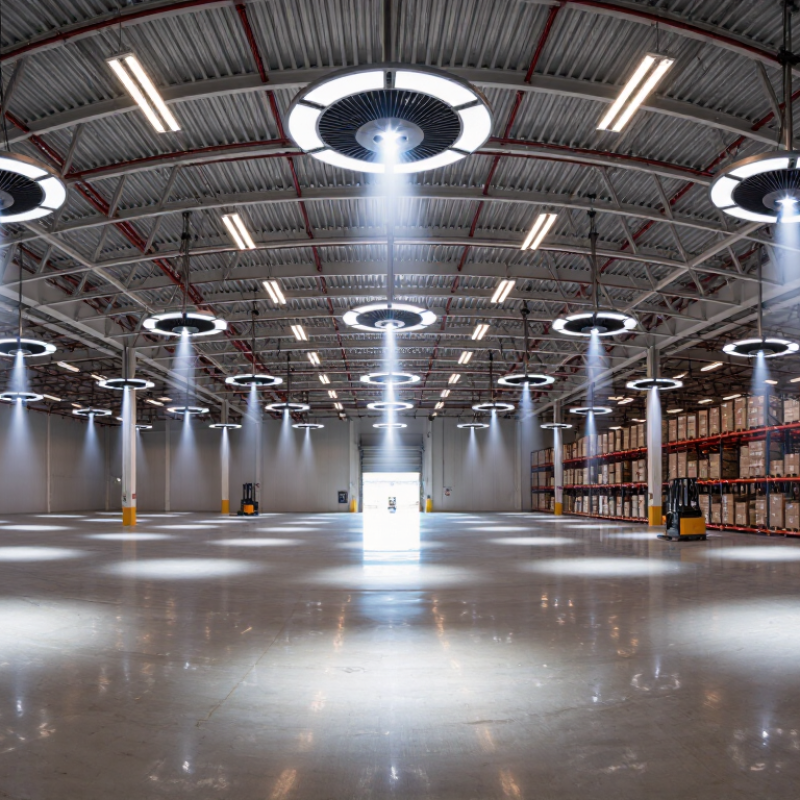
An LED high bay light is a ceiling-mounted fixture designed to illuminate large spaces from considerable heights, commonly around 20 feet or more. “High bay” describes the mounting environment, not one fixed fixture shape. These lights are used in warehouses, factories, gyms, and distribution centers, where ordinary ceiling lights may leave work surfaces dim. Their purpose is to deliver broad, usable light across floors, aisles, and work areas while controlling energy use. The fixture’s lens or reflector shapes the beam. Its output and mounting height should suit the room.
Details matter. A bright fixture can still create glare or dark patches if its spacing and beam angle are poorly matched to the ceiling. The U.S. Department of Energy’s 2020 U.S. Lighting Market Characterization reported that LEDs accounted for about 48% of installed lighting units in 2018, reflecting their growing role in commercial lighting. Separately, the DOE’s 2019 Energy Savings Forecast of Solid-State Lighting projected potential U.S. lighting-energy savings of 569 terawatt-hours annually by 2035. That forecast covers general lighting, not high bay fixtures alone. For a specific building, fixture layout, operating hours, ceiling height, and task visibility still need attention. Even a well-chosen light can feel harsh.
What Is an LED High Bay Light? Definition and Purpose
LED high bay lights are designed for spaces with high ceilings, typically around 20 feet or more. They provide broad, efficient illumination for areas such as warehouses, gyms, and industrial workspaces. The chart shows representative maintained illuminance targets; actual lighting requirements vary with the task, layout, and applicable standards.
How LED High Bay Lights Work
An LED high bay light produces illumination when electrical current passes through semiconductor chips, releasing photons. In most white fixtures, a phosphor layer converts some blue light into a broader white spectrum. The driver regulates incoming AC power into the controlled current the LEDs need. It also affects dimming and performance. Heat matters. A metal heat sink carries warmth away from the chips; excessive heat can shorten component life. At a 30-foot warehouse ceiling, lenses or reflectors shape the beam so light reaches aisles and work surfaces, rather than spreading everywhere.
The U.S. Department of Energy’s Energy Saver guidance says LED products use at least 75% less energy and can last up to 25 times longer than incandescent lighting. That comparison is useful, but imperfect: warehouses often replace fluorescent or metal-halide fixtures, not incandescent bulbs. Actual savings depend on the old system, hours of operation, controls, and light levels. A motion sensor can reduce output in an empty aisle, while poor optics may leave dark patches below. Small details matter. Installation height and beam angle should be checked against the space, not guessed from a catalog.
Key Components and Design Features
An LED high bay light is a ceiling-mounted fixture designed for tall spaces such as warehouses, gyms, and workshops. Its performance depends on several parts working together. The LED board produces light; the driver converts incoming power into controlled current. A heat sink draws warmth away from the LEDs, helping limit heat-related output loss. Optics, often lenses or reflectors, shape the beam toward aisles, workbenches, or open floors. Small details matter.
The housing protects these components, while hooks, pendants, or brackets secure the fixture overhead. Many models also accept dimming or occupancy controls, but compatibility should be checked before installation. A bright fixture can still leave dark shelving if its beam angle is poorly matched to the room. That part is easy to overlook. The U.S. Department of Energy’s 2022 Solid-State Lighting R&D Opportunities report estimates that solid-state lighting could enable about 569 terawatt-hours of annual U.S. electricity savings by 2035, compared with its baseline. This broad projection is not a guarantee for any single building. For a real specification, compare measured efficacy, light distribution, and driver details, and review lifetime claims against recognized testing methods such as IES LM-80 and TM-21.
What Is an LED High Bay Light? - Key Components and Design Features
| Component or Feature | What It Is | Typical Design Details | Why It Matters |
| LED light source | Arrays of light-emitting diodes mounted on a circuit board. | Often uses multiple LED packages arranged to distribute light across the fixture’s optical surface. | Produces the light while using less energy than many traditional high-intensity discharge fixtures. |
| Optical system | Lenses or reflectors that direct and shape the light. | Common beam distributions include narrow, medium, and wide patterns; the appropriate choice depends on mounting height and aisle layout. | Helps deliver light to work surfaces while limiting unwanted spill and glare. |
| LED driver | Electronic power supply that regulates current to the LEDs. | May support common building supply voltages and dimming methods such as 0–10 V, depending on the model. | Provides stable LED operation and can enable dimming or integration with lighting controls. |
| Heat sink and thermal path | Metal surfaces and internal connections that move heat away from the LEDs and driver. | Frequently uses finned aluminum housing or a dedicated heat sink to increase heat-dissipating surface area. | Managing heat helps maintain light output and supports reliable operation over time. |
| Housing and mounting | The protective enclosure and hardware used to install the fixture. | Common configurations include a round “UFO” form or a linear form, with hooks, chains, or other mounting options. | Provides structural support and allows the fixture to suit different ceiling and facility layouts. |
| Ingress protection | A rating that indicates resistance to dust and water under specified test conditions. | Ratings such as IP65 are available on some fixtures; the required rating depends on the installation environment. | Helps determine whether a fixture is appropriate for dusty or damp locations. Check the product rating for the exact conditions covered. |
| Color characteristics | Correlated color temperature (CCT) and color rendering index (CRI). | High bay products commonly offer neutral-to-cool white options, often around 4000 K or 5000 K, and CRI values of 80 or higher. | Influences the perceived appearance of the space and how clearly colors are distinguished. |
| Lighting controls | Optional sensors or control interfaces for adjusting light output. | Options may include occupancy or motion sensing, daylight response, and scheduled dimming. | Can reduce energy use when spaces are unoccupied or receive sufficient daylight, where compatible controls are installed. |
| Typical applications | Large indoor areas with high ceilings. | Common settings include warehouses, factories, gyms, and distribution spaces; mounting heights often start around 15 feet, but vary by site. | High-output light distribution is designed for spaces where ordinary low-ceiling fixtures may not provide suitable coverage. |
Common Applications and Installation Environments
An LED high bay light is designed to illuminate spaces with high ceilings, often around 20 feet or more. Its focused, powerful output helps light floors, workstations, and storage areas from above. Unlike ordinary ceiling fixtures, high bays are selected for mounting height, beam spread, and the tasks below. A narrow beam can suit tall shelving, while a wider beam may cover an open workshop. Height matters.
Common applications include warehouses, factories, gymnasiums, aircraft hangars, and large retail spaces. These environments often have broad floor areas, tall ceilings, and long operating hours. In a warehouse, even light can make labels easier to read between shelving rows. In a workshop, good color rendering can help workers distinguish wires, finishes, or small parts. Dust changes things. For damp or dusty locations, check the fixture’s stated protection rating and follow the site’s electrical requirements. A high ceiling alone does not determine the right fixture; layout, obstructions, and the type of work matter too. One detail is easy to overlook: racks or machinery can cast deep shadows.
Tips: Measure ceiling height and note obstacles before choosing beam angles. Have a qualified electrician confirm mounting and wiring. Test the light pattern in one area first; real spaces rarely match a clean floor plan.
Types and Factors to Consider When Choosing One
LED high bays illuminate large spaces with high ceilings, such as warehouses, workshops, and gymnasiums. Common types include round UFO fixtures, linear high bays, and retrofit kits for existing housings. UFO models suit open floor plans; linear fixtures often fit aisles and long work areas. The U.S. Department of Energy’s 2020 U.S. Lighting Market Characterization estimated that lighting used 208 terawatt-hours in 2018. That was about 5% of national electricity use, making efficient fixture selection worthwhile.
Match light output and beam distribution to ceiling height, aisle layout, and task detail. Check a photometric layout, not just the lumen figure: bright spots and dark gaps are real problems. Compare efficacy, measured in lumens per watt, and consider color temperature and color rendering for the work being done. Dust, moisture, ambient heat, dimming controls, and sensor compatibility also affect performance. A sleek specification sheet can still disappoint on a hot, dusty ceiling. Verify the warranty and operating conditions.
Tips: Before replacing fixtures, note mounting height and spacing, then test one unit in the actual space. A quick evening check can reveal glare, shadows, or uneven coverage that a catalog may miss.
