
China Top 10 PU Sandwich Panel Suppliers for Global Buyers

Choosing reliable PU sandwich panels suppliers in China requires more than comparing prices or browsing polished product catalogs. Global buyers need consistent insulation performance, accurate dimensions, dependable production, and clear export communication. This guide introduces ten Chinese suppliers serving international markets, with attention to practical purchasing concerns.

The evaluation considers panel thickness, core density, metal coating, joint design, thermal conductivity, and available surface finishes. Fire-performance documentation deserves careful review. So does factory experience. Buyers should request current test reports, certification details, production photos, and sample panels before placing large orders. A useful sample can reveal uneven foaming, weak edges, or coating defects that online images cannot show.

Delivery capability also matters. Suppliers may offer cold-room panels, warehouse systems, cleanroom solutions, and prefabricated building materials. However, product quality can vary between batches. No supplier is perfect. That point deserves honest attention. A strong manufacturer should explain limitations, confirm tolerances, and provide realistic lead times instead of making vague promises. Packaging quality is equally important, especially when containers travel through humid ports and repeated handling.

This overview is designed for contractors, distributors, engineers, and project owners comparing Chinese manufacturers. It emphasizes verifiable information rather than unsupported claims. Company background, technical support, customization ability, export experience, and after-sales response all influence the final decision. Local building requirements must still be checked independently. The shortlist offers direction, not a substitute for technical due diligence.
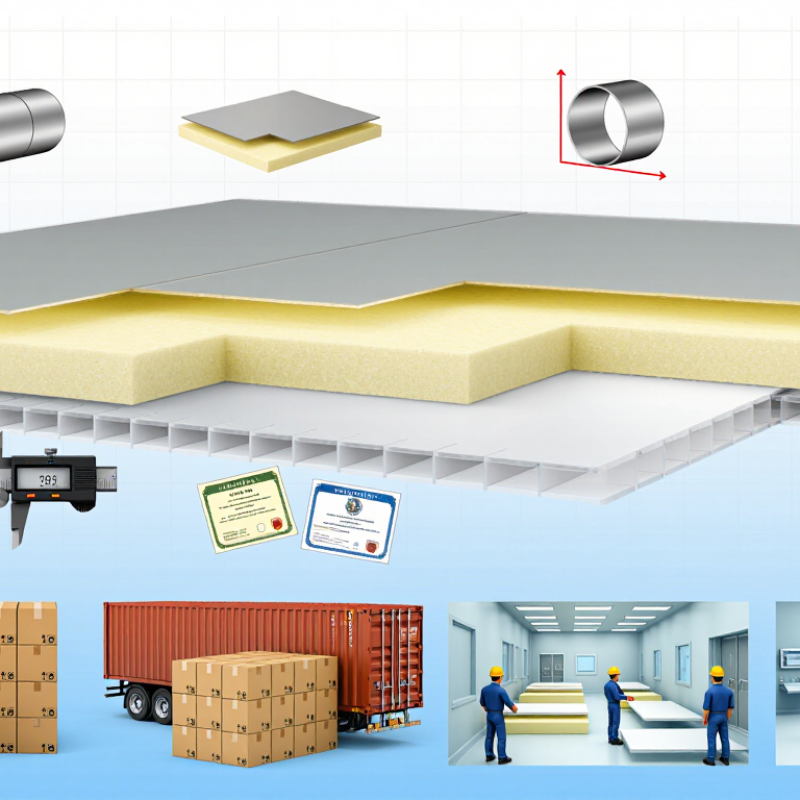
China Top 10 PU Sandwich Panel Suppliers for Global Buyers

PU Sandwich Panels: Structure, Materials, and Core Performance

PU sandwich panels combine two protective facings with a rigid polyurethane foam core. The facings commonly use coated steel, aluminum, or other corrosion-resistant sheets. Their profiles improve stiffness and guide rainwater away from joints. The foam core reduces heat transfer through the building envelope. It also adds limited structural support between the outer skins. This design stays relatively light during transport and installation. Keep joints tight. Small gaps can reduce insulation and invite condensation.

Panel performance depends on core density, thickness, closed-cell quality, and bonding strength. A thicker core generally lowers the U-value, but climate and indoor conditions also matter. Polyurethane provides strong insulation with modest thickness, helping preserve usable floor space. However, it is not suitable for every application automatically. Buyers should request tested fire behavior, dimensional stability, moisture resistance, and declared thermal conductivity. Test conditions matter. Unclear laboratory data deserves careful questioning.

On site, I would inspect edge alignment, screw placement, sealant continuity, and protective film removal. These details often decide whether a good panel performs well. Factory quality control should cover foam mixing, lamination pressure, thickness tolerance, and coating adhesion. Global buyers should compare packaging, loading methods, installation guidance, and traceable inspection records. A low quotation may hide thinner steel or inconsistent foam. That risk is easy to underestimate. Specifications should match the actual building, not merely look impressive in a tender document.

China’s Leading PU Sandwich Panel Suppliers at a Glance

China’s leading PU sandwich panel suppliers serve cold storage, cleanrooms, warehouses, and modular buildings worldwide. Fortune Business Insights estimated the global sandwich panels market at USD 14.31 billion in 2023. It projects approximately USD 22.91 billion by 2032. This growth increases demand for stable thermal performance, fast installation, and traceable production.

Reliable suppliers usually show more than attractive catalogs. Buyers should check core density, thermal conductivity, panel thickness, joint design, and dimensional tolerance. Factory audits can reveal important details, including foam injection control, steel coating quality, and storage conditions. Independent fire and mechanical test reports are valuable evidence. They should match the proposed production specification.

Energy performance remains a practical concern. The International Energy Agency reports that buildings consume about 30% of global final energy. Well-designed insulated envelopes can reduce heat transfer, especially in refrigerated facilities and large industrial halls.

However, PU panels do not solve every problem. Poor sealing can undermine good insulation. Some suppliers still present laboratory values without explaining installation conditions. That deserves careful questioning. Details matter.

Long-term buyers should request recent batch records, sample panels, warranty terms, and export references for comparable climates. Certification alone is insufficient. A supplier’s response to technical questions often reveals more than its marketing language. Price comparisons are useful, but they can hide differences in steel thickness, foam density, accessories, and after-sales support. That is the uncomfortable part.

Supplier Profiles: Products, Manufacturing, and Export Capabilities

China’s top PU sandwich panel suppliers serve warehouses, cold rooms, workshops, and modular buildings worldwide. Their product ranges usually include wall panels, roof panels, cold storage panels, and fire-resistant options. Core specifications include panel thickness, steel coating, polyurethane density, joint design, and thermal performance. Professional suppliers provide technical data sheets, sample sections, and test reports from recognized laboratories.

Manufacturing quality depends on more than automated foaming lines. Experienced factories control core density, curing time, lamination pressure, and steel surface protection. Good suppliers also inspect panel flatness, locking accuracy, and edge sealing before packing. Some operate dedicated production lines for different thicknesses, reducing changeover errors. However, factory claims still need verification. A video tour is useful, but an independent inspection may reveal problems that photographs hide.

Export capability involves more than offering a low quotation. Reliable suppliers understand container loading, moisture protection, labeling, documentation, and destination requirements. They should confirm production lead time, replacement procedures, and after-sales technical support in writing. Tips: Request a physical sample, compare test reports, and calculate usable coverage after joint overlap. Ask how panels are protected during sea transport. Small details matter. Buyers should also check whether the proposed fire and insulation performance suits the local project rules. No supplier is perfect; unclear communication, changing specifications, or rushed promises deserve careful review.

China PU Sandwich Panel Suppliers for Global Buyers

This chart summarizes commonly offered PU sandwich panel thicknesses by application in the Chinese export market. The figures are industry reference values rather than company-specific data. Thicker panels are typically selected for cold storage and high-insulation projects, while wall, roof, cleanroom, and partition systems commonly use lighter thickness ranges.

How to Compare Quality, Certifications, Prices, and Lead Times

China Top 10 PU Sandwich Panel Suppliers for Global Buyers

Quality comparison should begin with testable figures, not surface appearance. Check core density, panel thickness, thermal conductivity, bond strength, water absorption, and dimensional tolerance. EN 14509 defines performance requirements for factory-made insulated panels. For fire safety, request reports under EN 13501-1 or the relevant local standard. ISO 9001 supports process control, but it does not prove every panel meets your specification. I would not trust a certificate screenshot alone.

Price must be compared per square metre, with the same thickness, coating, steel grade, accessories, packaging, and delivery terms. A lower quote may hide thinner steel or incomplete edge details.

The 2023 UNEP Global Status Report states that buildings and construction account for about 37% of global energy-related and process emissions. Better insulation can reduce operating demand, but the payback depends on climate and building use. This part is often oversimplified.

Lead time needs a written schedule. Separate sample approval, technical drawing approval, production, loading, and ocean transit. Ask for weekly production capacity and a realistic buffer for peak seasons. The International Energy Agency’s Buildings 2023 report highlights continuing pressure to improve building efficiency, increasing demand for reliable insulation products. Still, reports do not replace factory evidence. Review recent test dates, batch records, packing photos, and a pre-shipment inspection. Mistakes happen. A perfect promise is less credible than a clear risk plan.

Key Factors for Selecting a Reliable Chinese PU Panel Supplier

Choosing a reliable Chinese PU sandwich panel supplier requires evidence beyond attractive quotations. The 2023 Global Status Report for Buildings and Construction reports that buildings consumed about 30% of global final energy in 2022. It also generated 26% of energy-related emissions. Therefore, verify the panel’s declared thermal conductivity, density, joint design, and long-term dimensional stability. A low initial price can become expensive when cold bridges increase energy costs.

Request recent laboratory reports, not recycled certificates. Check fire performance against the destination market’s requirements, including EN 14509 or ASTM C1289 where applicable. Ask for batch numbers, production dates, raw material records, and testing temperatures. Details matter. A practical factory audit should examine coil storage, foam injection, curing time, cutting accuracy, and packaging under rain exposure. Measure sample thickness at several points. One reading is not enough.

Supplier reliability also depends on delivery discipline and technical communication. Review at least three recent export projects with similar panel thicknesses and climate conditions. Confirm warranty limits, replacement procedures, inspection responsibilities, and Incoterms in writing. The ISO Survey 2023 recorded more than 1.26 million valid ISO 9001 certificates worldwide, but certification alone does not prove product consistency. Paper is not proof. A polished factory visit can still hide weak batch control. Independent pre-shipment inspection may reveal scratches, uneven edges, or incomplete joint engagement. No checklist is perfect. Leave room for site-specific risks, especially humidity, wind loads, fire regulations, and installer capability.

China Top 10 PU Sandwich Panel Suppliers for Global Buyers - Key Factors for Selecting a Reliable Chinese PU Panel Supplier

Anonymized comparative shortlist based on commonly offered PU panel specifications, export capabilities, quality documentation, and buyer-verification factors.

Rank / Supplier Profile Typical Applications Common Core Thickness Typical PU Density Thermal Conductivity Facing Options Fire-Performance Documentation Export & Customization Indicators Buyer Verification Checklist Indicative Score
1. Profile A Cold rooms, food-processing facilities, warehouses 50–200 mm 38–42 kg/m³ Approximately 0.022–0.024 W/m·K Pre-painted steel, stainless steel, aluminum Request EN 13501-1 or equivalent test reports for the complete panel assembly Cut-to-length production; export packing; drawings available on request Verify adhesive system, joint design, flatness, dimensional tolerance, and batch records 9.4/10
2. Profile B Industrial buildings, logistics centers, agricultural structures 40–150 mm 38–40 kg/m³ Approximately 0.022–0.025 W/m·K Galvanized steel, aluminum, coated steel Fire test evidence should identify core, facings, joints, and test configuration High-volume production; standard profiles; container-loading support Check coating thickness, steel grade, panel length limits, and loading method 9.2/10
3. Profile C Refrigerated distribution, freezer rooms, clean spaces 75–200 mm 40–45 kg/m³ Approximately 0.021–0.024 W/m·K Food-grade coated steel, stainless steel, smooth metal sheets Require smoke, flame-spread, and reaction-to-fire documentation where applicable Cam-lock or tongue-and-groove options; project-based fabrication Confirm hygienic finish, vapor-tight joints, cam-lock strength, and temperature range 9.1/10
4. Profile D Roofing, wall cladding, modular buildings 30–120 mm 36–40 kg/m³ Approximately 0.023–0.026 W/m·K Pre-painted galvanized steel, embossed steel, aluminum Request project-specific fire classification rather than relying only on raw-material certificates Multiple surface finishes; standard export dimensions; accessory matching Assess wind-load tables, span capacity, screw detailing, and weather sealing 8.9/10
5. Profile E Portable cabins, site offices, prefabricated housing 40–100 mm 36–40 kg/m³ Approximately 0.023–0.026 W/m·K Color-coated steel, aluminum, interior decorative sheets Verify certificates for the final decorative facing and panel configuration Small-project customization; door, window, and trim coordination Check minimum order quantity, color consistency, accessory tolerances, and installation manuals 8.7/10
6. Profile F Industrial partitions, workshops, equipment enclosures 40–100 mm 38–42 kg/m³ Approximately 0.022–0.025 W/m·K Galvanized steel, stainless steel, corrosion-resistant coatings Confirm certification scope, test date, and whether joints were included Fast quotation cycle; standard accessories; mixed-size orders may be possible Review impact resistance, surface hardness, joint compression, and replacement-panel policy 8.6/10
7. Profile G Commercial kitchens, food factories, laboratories 50–150 mm 40–45 kg/m³ Approximately 0.021–0.024 W/m·K Stainless steel, hygienic coated steel, smooth metal facings Request reaction-to-fire and smoke data for the exact surface system Cleanroom-compatible detailing; sealed joints; project drawings Verify cleanability, sealant compatibility, corner details, and surface flatness 8.5/10
8. Profile H Agricultural buildings, livestock facilities, storage sheds 30–100 mm 36–40 kg/m³ Approximately 0.023–0.026 W/m·K Coated steel, galvanized steel, corrosion-resistant finishes Obtain fire documentation and corrosion-resistance information for the intended environment Cost-focused production; standard lengths; basic accessory packages Check ammonia resistance, coating system, condensation control, and ventilation design 8.3/10
9. Profile I Retail buildings, sports facilities, temporary structures 40–120 mm 38–42 kg/m³ Approximately 0.022–0.025 W/m·K Pre-painted steel, aluminum, architectural finishes Require independent or accredited test evidence where local codes demand it Color and profile customization; export documentation support Evaluate appearance consistency, load tables, fastener layout, and replacement availability 8.1/10
10. Profile J General-purpose enclosures, workshops, low-rise construction 30–100 mm 36–40 kg/m³ Approximately 0.023–0.026 W/m·K Pre-painted steel, galvanized steel, aluminum Confirm the actual fire rating instead of accepting general “fireproof” claims Standard product range; competitive minimum order quantities; export packing available Inspect samples, verify thickness and density, review warranty terms, and conduct pre-shipment inspection 7.9/10
Important buyer note: The figures above are indicative market ranges for anonymized supplier profiles, not guaranteed specifications or independently verified rankings. Before placing an order, request current technical datasheets, accredited test reports, production samples, quality certificates, drawings, warranty terms, and a pre-shipment inspection. Thermal conductivity values depend on test method, temperature, density, aging, and panel construction.
Facebook Twitter Instagram Linkedin Youtube