
Who Are the Best Artificial Marble Suppliers in China?

Choosing an Artificial Marble supplier in China is not just a matter of comparing prices or browsing polished showroom photos. A slab can look flawless under bright lights, yet show uneven veining, color variation, or edge chips after delivery. Buyers should examine sample consistency, thickness tolerances, surface finish, production capacity, packaging, and documented quality checks. Details matter.

Materials scientist Dr. Andrew Ruys has written about engineered stone. A practical paraphrase of his materials-science perspective is: “Composition and manufacturing control shape how an engineered surface performs.” That idea is useful when assessing suppliers. Ask what resins and mineral fillers they use, how they inspect finished slabs, and whether production samples match the shipment. Request clear photos of the actual batch, not only catalog images. Check how corners are protected inside crates. Small details can reveal a lot.

This guide compares Chinese suppliers through product range, customization, quality controls, export experience, and communication. It also considers how well each company explains its specifications and handles questions before an order. No supplier is best for every project. A hotel renovation may need dependable volume and repeatable color, while a small interior studio may value unusual patterns and flexible quantities. Even careful checks cannot remove every risk. That deserves a second look.
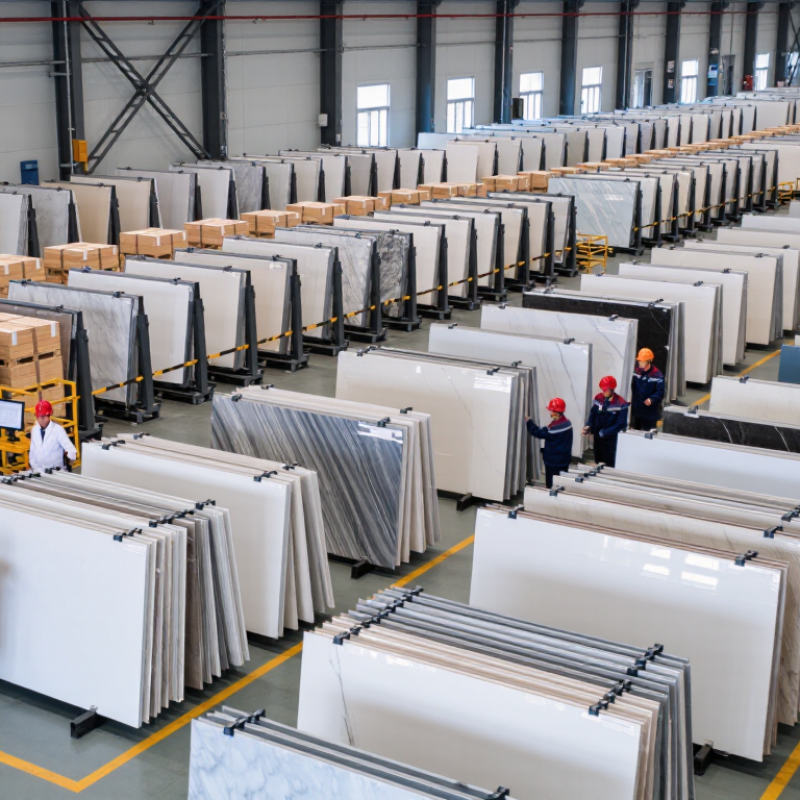
Who Are the Best Artificial Marble Suppliers in China?

What Is Artificial Marble? Materials, Manufacturing, and GB/T 35165-2017

Artificial marble is a manufactured decorative surface, not a single fixed recipe. It commonly combines marble or other mineral particles with a binder, pigments, and additives. Resin-bound products are formed by mixing, molding, and curing the ingredients; cement-bound versions use a mineral-based binder. The precise formula affects appearance, water absorption, strength, and maintenance needs. Details matter. A polished sample can look convincing, but its surface alone cannot show how it will perform after years of use.

Production often includes blending, compacting or vibrating the mix, curing, then cutting and polishing slabs. Some factories use vacuum processes to reduce trapped air, though equipment and controls vary. GB/T 35165-2017, titled Artificial Stone for Building Decoration, provides relevant product requirements and test methods in China. Buyers should check the applicable standard text and request product-specific test reports, rather than relying on a general claim of compliance. Compare slab samples, thickness tolerance, surface finish, and stated test results. One point deserves caution: “artificial marble” is used broadly in trade, so products with similar names may differ substantially in composition. The label alone is not enough.

How Do Water Absorption and Flexural-Strength Test Results Compare?

Water absorption and flexural strength reveal different sides of artificial marble performance. Low absorption can reduce staining and moisture-related concerns, but it does not prove a slab is mechanically strong. Flexural strength indicates how well a specimen resists bending before it cracks. Both results matter.

Compare reports only when the test method, specimen thickness, curing, and conditioning are consistent. A result of 0.3% absorption is not directly comparable with 0.5% if the samples were prepared differently. The same caution applies to flexural strength, usually reported in megapascals. Check whether specimens were tested lengthwise, crosswise, or in both directions. Small differences matter. So does the sample edge.

In supplier evaluations, ask for recent third-party reports tied to the actual product grade, not just a general catalogue sheet. A strong result on one small coupon may not predict a full slab with uneven resin distribution or visible mineral clusters. I would look for repeat tests and clear sample identification. One tidy table is not proof. Honestly, buyers can still miss flaws that appear only after cutting or installation. Ask how the supplier controls batch variation, and compare several slabs under the same inspection conditions.

Which Suppliers Match Your Needs for Capacity, Slab Size, and Finish?

Choosing a Chinese artificial marble supplier starts with your project’s actual production needs. Grand View Research estimated the global engineered stone market at USD 23.1 billion in 2023, with growth projected through 2030. That market context makes capacity worth checking, but it does not verify any factory’s claims. Ask for monthly output by product type, recent production records, and lead times for repeat orders. Also confirm whether the quoted capacity includes polishing, inspection, and packing. A polished sample is not proof of batch consistency.

Size matters. Request the usable slab dimensions, thickness tolerance, and packing details, then compare them with your cutting plan and container limits. A nominal 3,200 × 1,600 mm slab may not provide that full usable area after edge defects or trimming. Finish needs equal care: ask for physical samples of polished, honed, or matte surfaces, and check them under your project’s lighting. Sample and batch can differ. For veined designs, request photos from the same production lot and agree on acceptable variation before ordering. These checks take time, but skipping them can mean more waste, delayed installation, and costly rework.

Who Are the Best Artificial Marble Suppliers in China?

Compare representative slab formats to identify which suppliers may fit your project requirements.

These are representative market formats, not supplier-specific guarantees. Actual dimensions and tolerances vary. To assess capacity and finish options, request current production capacity, project-specific lead times, and physical finish samples directly from each supplier.

How Can Buyers Verify Factory Audits, Certifications, and Export Records?

A credible supplier check starts with matching identities. Compare the factory’s registered name and address across its business license, audit report, certificates, and export documents. Ask for a recent third-party factory audit, including its scope, inspection date, corrective actions, and auditor details. A certificate alone is not proof of consistent production. The ISO Survey 2022 recorded 1,265,216 ISO 9001 certificates worldwide, but that figure counts certificates, not verified factories or product quality.

Check whether the certificate issuer can confirm validity and whether its scope covers stone processing, not an unrelated activity. During a live video tour or site visit, look for slab inventory, cutting equipment, dust controls, and batch labels. Request test reports for the exact artificial marble grade you plan to buy, then match sample codes to production records. Small mismatches matter.

For export history, request redacted bills of lading, commercial invoices, packing lists, and certificates of origin from recent shipments. Compare dates, product descriptions, quantities, and shipper names; use UN Comtrade trade data as a country-level cross-check, not proof of an individual supplier’s shipments. Still, paperwork can mislead. A buyer should confirm a sample shipment directly with the named freight forwarder when possible, while recognizing that older records may not reflect current capacity.

Who Are the Best Artificial Marble Suppliers in China? — How Buyers Can Verify Factory Audits, Certifications, and Export Records
Evaluation Area Evidence to Request How to Verify It Strong Verification Result
Legal business identity Chinese legal entity name, business licence, registered address, and unified social credit code. Check the entity through China’s National Enterprise Credit Information Publicity System. Compare the registered business and address with the sales contract, invoice, and factory details. The contracting and payment entities are clearly identified, and the registration details are consistent. A trading company should disclose its relationship to the manufacturing site.
Factory audit Recent audit report, audit date, site address, scope, auditor identity, findings, and corrective-action records. Confirm the report directly with the audit provider where possible. Check that the audited site and production processes cover the artificial-marble products being purchased; arrange an independent on-site or live video audit if needed. The report is recent, site-specific, and includes findings and follow-up actions—not just a certificate or a one-page summary.
Quality management certification Certificate number, certified legal entity and site, scope, issue and expiry dates, and certification body. Verify the certificate with the issuing certification body and, where applicable, its accreditation body. Confirm that the site and scope match the supplier and product operation. The certificate is current and independently verifiable. Certification supports a management-system assessment; it does not by itself prove product quality.
Product test reports Reports for the exact product type, thickness, finish, and intended application, including the test methods and sample identification. Check the laboratory, report number, date, methods, and whether the tested sample is representative of the quoted product. Confirm any destination-market requirements with the buyer’s importer or local authority. Results are traceable to the product being purchased and address the buyer’s stated performance requirements. Do not treat a report for a different material or product range as proof.
Export experience Redacted bills of lading, commercial invoices, packing lists, or other shipment records showing product description, shipment date, and destination where disclosure is permitted. Cross-check dates, product descriptions, shipment details, and the exporting entity across documents. Where records are obtained from a third-party trade-data service, confirm its coverage and data limitations. Documents are consistent and demonstrate relevant shipments. Trade-data availability varies by country, carrier, and service; missing public data alone does not prove that a supplier has no export history.
Production capability Current production-line information, equipment list, monthly capacity basis, staffing or shift assumptions, and recent production records. Review the information during a factory audit and compare stated capacity with equipment, staffing, lead times, and the proposed order quantity. Capacity claims are supported by observable equipment and realistic production planning rather than an unsupported headline figure.
Sample and batch consistency Signed or approved reference sample, product specifications, color and finish details, and a documented inspection plan for the order. Agree on acceptance criteria before production. Inspect pre-production samples and, for larger orders, arrange a pre-shipment inspection using the agreed specifications. The approved sample, purchase order, production records, and inspection results refer to the same product specifications and acceptance criteria.
Traceability and corrective action Batch or lot identification, inspection records, complaint procedure, and examples of corrective-action documentation. Ask the supplier to trace a selected finished batch back to its production and inspection records, and review how nonconforming products are handled. Records connect production batches to inspection results, and corrective actions include documented follow-up.
Overall supplier selection A completed evidence checklist covering legal identity, factory audit, relevant certifications, product testing, export documents, and sample approval. Score each area using the buyer’s own requirements; mark evidence as verified, pending, or not applicable. Resolve discrepancies before paying a deposit or approving shipment. The strongest candidate is the supplier with the most relevant, current, and independently checkable evidence—not simply the largest claimed capacity or the most certificates.

What Quote Data Matters Most: Thickness, MOQ, Lead Time, and Warranty?

When comparing artificial marble suppliers in China, ask for a quote tied to the exact slab or finished-item specification. Thickness can affect weight, edge appearance, and installation fit. Request the nominal and measured thickness, plus the allowed tolerance, in millimetres. A stated 15 mm panel is not enough if variation is unclear. Ask whether the price includes polishing, cut-outs, and protective packing. Small details matter. MOQ should specify units, finish, and color grouping. Confirm whether mixed colors count toward one order. Not glamorous, but useful.

Lead time should separate sample approval, production, and dispatch. Request calendar days and the event that starts the schedule, such as deposit receipt or drawing approval. Ask how delays are communicated. For warranty, get the coverage period, covered defects, exclusions, and claim evidence in writing. Photos, batch labels, and packing records can help resolve disputes. Check whether coverage includes replacement freight or only the material itself. I would double-check this part: buyers may assume a warranty includes installation costs, but the quote may not. Compare matching specifications, not just the final price.

Facebook Twitter Instagram Linkedin Youtube